
Lake Tanganyika Aquariums
Descend into the second-oldest and second-deepest lake on Earth — a vast, crystal-clear rift valley sea whose rocky shores and sandy shallows have produced one of the most spectacular explosions of cichlid diversity anywhere in nature.
Where in the World
Lake Tanganyika lies within the western branch of Africa's Great Rift Valley, bordered by Tanzania, the Democratic Republic of Congo, Burundi and Zambia. Formed roughly 9 to 12 million years ago as tectonic plates pulled apart, it is the longest freshwater lake in the world at around 673 km, and the second-deepest after Lake Baikal, plunging to depths of nearly 1,470 metres.
Unlike the Amazon's flooded forests, Tanganyika is a lake of hard edges and open water: sheer rock walls dropping straight into the depths, boulder-strewn shoreline shallows, wide expanses of clean sand, and — below a certain depth — a permanently oxygen-free "dead zone" where almost nothing can survive. Fish here have carved out tightly specialised niches within just the uppermost, oxygenated layer of water.
Because the lake is so old and so isolated, evolution has run wild inside it. Cichlids that colonised the lake millions of years ago radiated into hundreds of endemic species found nowhere else on the planet, each adapted to a specific rock crevice, sand bed, or open-water niche — a living laboratory of evolution that rivals the Galápagos in scientific importance.
The lake's clear, mineral-rich water is a product of its geology: surrounded by ancient volcanic and metamorphic rock, with very little organic run-off, the water that reaches Tanganyika's shallows is exceptionally clear, hard, and alkaline — the polar opposite of a soft, acidic Amazon blackwater stream.
Field Notes
- Location: Western Great Rift Valley, bordered by Tanzania, DR Congo, Burundi & Zambia
- Age: Approximately 9–12 million years — one of the oldest lakes on Earth
- Depth: Up to ~1,470 m; the second-deepest lake in the world
- Endemism: Hundreds of cichlid species found nowhere else on Earth
- Habitat types: Rocky shoreline, open sand flats, shell beds, and open water
- Water character: Exceptionally clear, hard, and alkaline, with high dissolved mineral content
Water Chemistry
Did You Know
A Mouth Full of Babies
Most Tanganyikan cichlids are maternal or biparental mouthbrooders, carrying fertilised eggs and free-swimming fry inside a parent's mouth for weeks at a time to protect them from predators.
Snail Shells as Homes
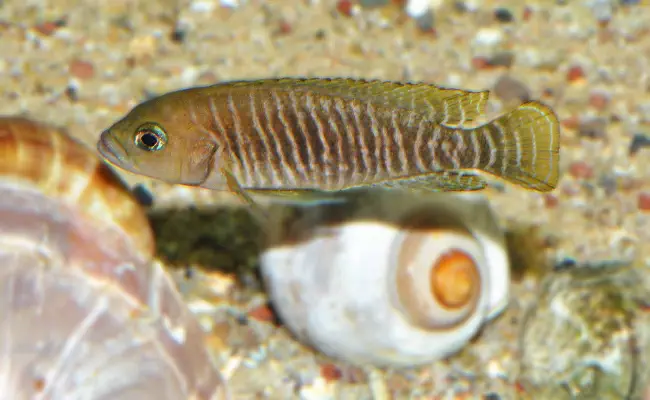
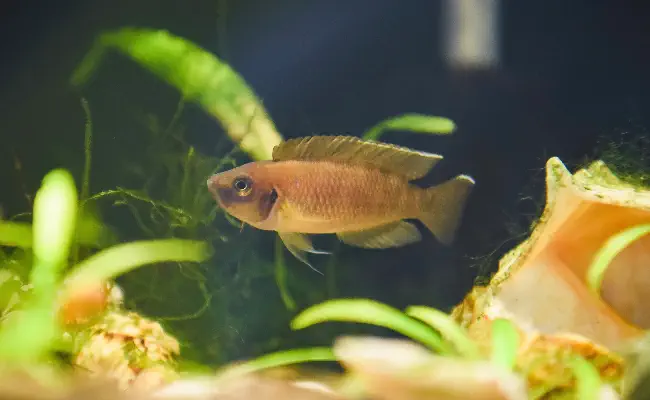
An entire group of dwarf cichlids — the "shell dwellers" — lives, breeds, and shelters exclusively inside empty freshwater snail shells scattered across the lake's sandy floor.
A Lake Older Than Its Fish Diversity Suggests
Despite the lake itself being millions of years old, most of its remarkable cichlid diversity evolved relatively recently in geological terms — a textbook case of rapid adaptive radiation.
Deadly Deep Water
Roughly 80% of Tanganyika's total volume lies below the oxygen-rich zone and is permanently anoxic — meaning the vast majority of this enormous lake is entirely uninhabitable to fish.
Living Rock, Not Decoration
The rocky shorelines many "Tropheus" and other rock-dwelling cichlids call home are coated in a thin biofilm of algae called "Aufwuchs" — their primary grazing food source in the wild.
Fiercely Territorial
Many Tanganyikan cichlids defend a single rock crevice or shell for their entire lives — a level of site fidelity and territorial aggression that shapes how hobbyists must stock and aquascape their tanks.
Life in the Rift Lake
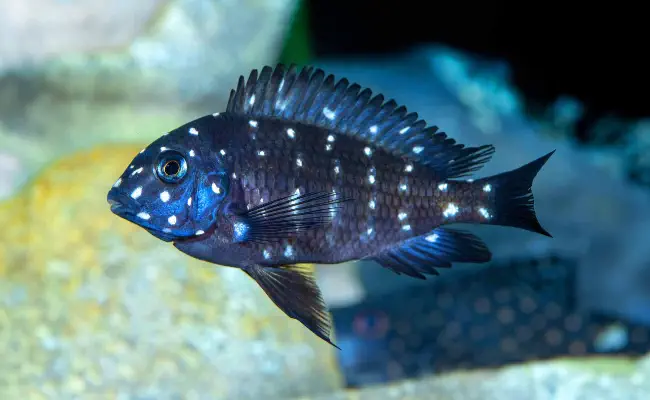
Tropheus
Tropheus moorii & othersDeep-bodied, algae-grazing rock dwellers found in large, roaming herds along rocky shorelines, prized for their striking colour morphs that vary dramatically by locality.
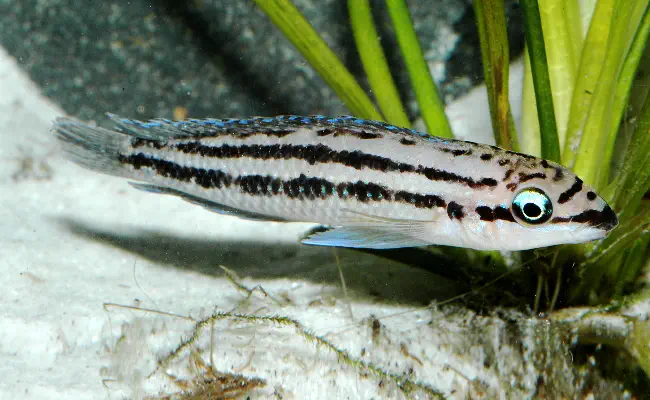
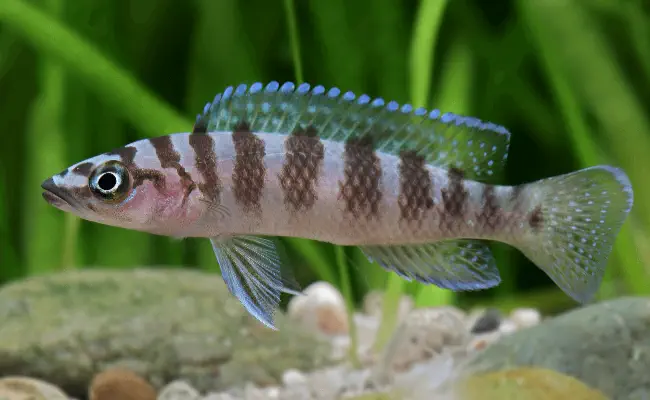
Julidochromis
Julidochromis spp.Slender, elongated cichlids that patrol rocky crevices in pairs, forming strong pair bonds and defending a chosen cave for years at a time.
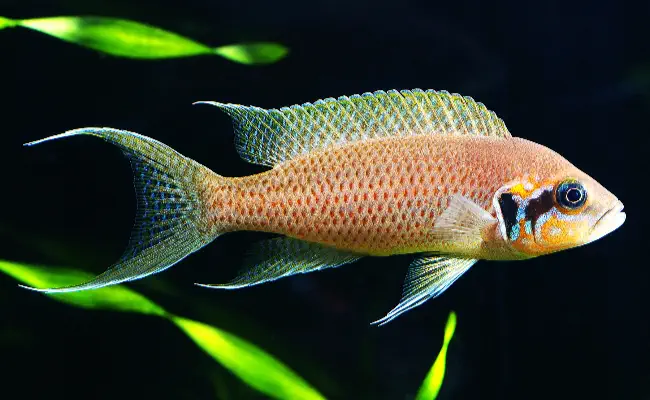
Brichardi / Fairy Cichlid
Neolamprologus brichardiA graceful, finnage-heavy cichlid known for complex family social structures, where older offspring help defend and raise their younger siblings — a rare trait among fish.
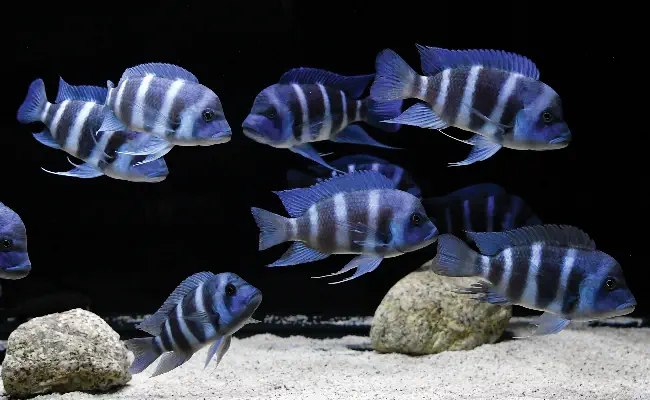
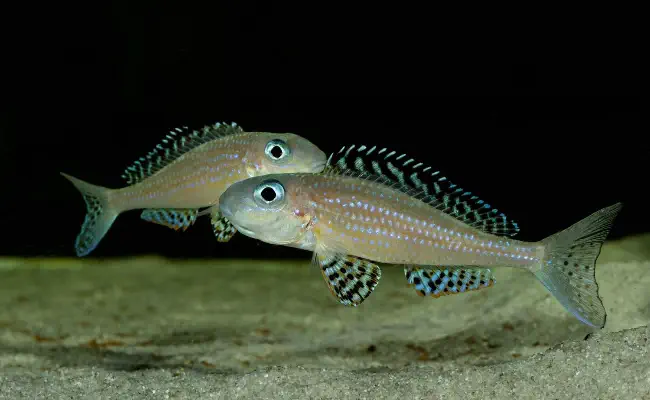
Frontosa
Cyphotilapia frontosaA large, striking deep-water cichlid with a distinctive nuchal hump, naturally found in loose colonies over deeper rocky slopes than most other Tanganyikans.
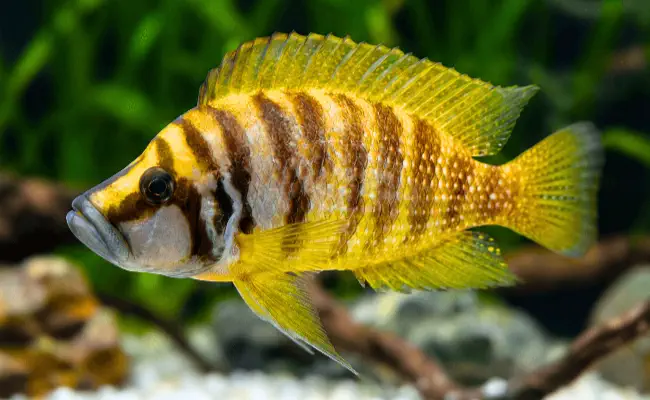
Calvis
Altolamprologus calvusA laterally compressed ambush predator built to slip sideways into narrow rock crevices — one of the most distinctively shaped cichlids in the entire lake.
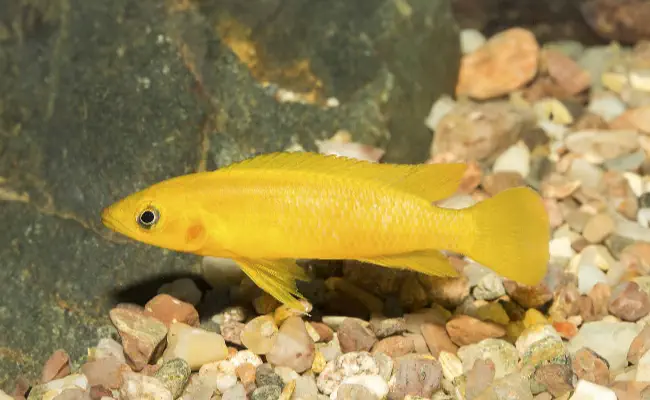
Leleupi / Lemon Cichlid
Neolamprologus leleupiAn unmistakable, vivid orange-yellow cichlid found along rocky drop-offs, whose colour intensifies dramatically under good diet and lighting in the home aquarium.
Recreating the Biotope
Hardscape & Substrate
A Tanganyikan tank is built around structure, not softscape. Stack rock securely (always against the glass or on a solid base, never resting on loose sand where it could shift and crack the tank) to create caves, crevices and territories, and use a fine, pale sand substrate for open sand-flat and shell-dweller zones. Live plants are optional and limited to a handful of hard-water-tolerant species — this is fundamentally a rockwork-and-open-water biotope, not a planted one.
Because so many Tanganyikan cichlids are intensely territorial, stocking density and rockwork layout matter enormously — enough caves and sightline breaks are essential to spread aggression across a tank rather than letting one dominant fish control it all.
Getting the Water Right
- Keep pH firmly alkaline (7.8–9.0) and hardness high — this is the opposite chemistry target to a softwater biotope like blackwater.
- Calcium-rich hardscape (holey rock, aragonite sand) helps maintain hardness naturally between water changes.
- Maintain excellent, stable water quality — Tanganyikan cichlids evolved in an enormous, chemically stable lake and are unforgiving of swings in pH or hardness.
- Research social structure carefully before stocking; mouthbrooding, pair-bonding and colony species each need very different group sizes and tank setups.
Curious About Building Your Own Biotope?
ECAAC members regularly build and show Tanganyikan and other biotope aquariums as part of our Aquascaping Awards Program. Come along to a meeting, ask questions, and get hands-on guidance from members who've done it before.