
Nano Aquarium Setup Guide
Small doesn't mean simple. Nano aquariums pack real challenges into a compact footprint — this guide covers what actually matters for tanks under 40 litres, from honest expectations to equipment, cycling, and shrimp-focused stocking.
The Honest Reality
Nano tanks are marketed heavily at beginners because of their low upfront cost and small footprint — but the truth is the opposite of the marketing. Small water volumes are far less forgiving than large ones. A mistake that barely registers in a 200L tank — a missed feeding, a skipped water change, a heater malfunction — can be catastrophic in a 15L tank within hours.
Temperature swings faster in less water. Ammonia spikes faster in less water. Evaporation changes parameters proportionally more in less water. None of this means nano tanks are a bad choice — it means they reward more attentive, more frequent maintenance, not less.
If you're completely new to the hobby, a 40–60L tank is genuinely a gentler starting point than anything under 20L, despite what marketing suggests. If you already have some fishkeeping experience and want a focused, low-footprint project, a well-planned nano tank can be extremely rewarding.
Cycle It Properly — There Are No Shortcuts in a Small Tank
The nitrogen cycle takes the same 4–6 weeks in a 15L tank as it does in a 200L tank — but the consequences of skipping it hit much faster and harder in less water. See our Nitrogen Cycle guide before stocking anything.
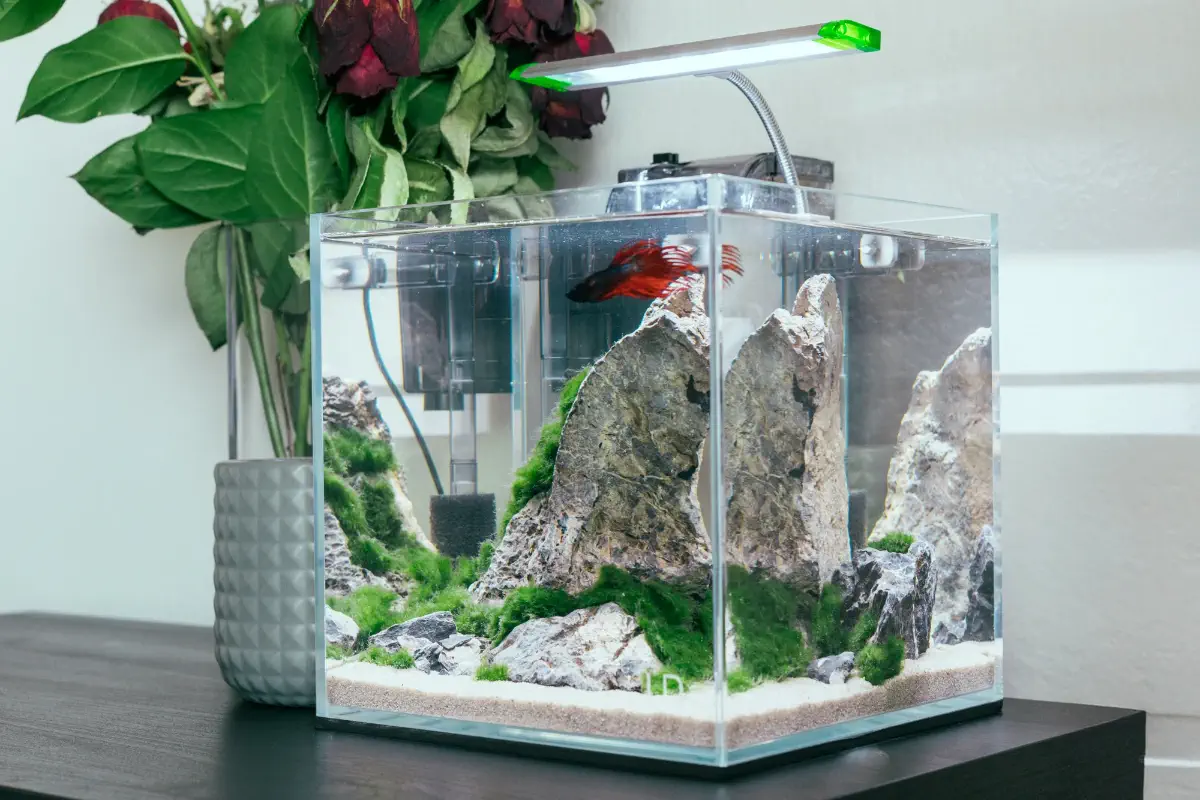
Nano Tank Sizes
Pico Tank
Extremely small — desk-tank territory. Only suitable for shrimp-only setups or a single betta with excellent maintenance discipline. Not recommended for a first tank; parameter swings happen within hours, not days.
Small Nano
The classic "nano" range — suitable for shrimp colonies, a small nano fish shoal (chili rasboras, ember tetras), or a single small centrepiece fish. Requires weekly, disciplined maintenance.
Large Nano
The most forgiving nano range — enough volume to buffer minor mistakes while staying compact. A good sweet spot for a first nano project, supporting a small community of nano fish plus shrimp.
Equipment That Actually Matters
Filtration
A small sponge filter or nano-rated internal filter is usually sufficient — but flow must be gentle enough not to blast small fish or shrimp against the glass. Sponge filters are the safest choice for shrimp-only tanks since there's no intake risk to babies.
Heating
A nano-rated heater with an accurate, reliable thermostat is critical — small water volumes swing temperature fast if a heater sticks on or fails. A cheap, inaccurate heater is more dangerous in a small tank than a large one.
Lighting
A small, dedicated nano LED fixture is worth buying rather than repurposing a larger light — precise, adjustable intensity matters more in a small footprint where algae and plant balance tips easily.
Test Kit
A full liquid test kit is non-negotiable, arguably more important than in a larger tank — problems escalate faster and testing regularly is the only way to catch a spike before it's fatal.
Realistic Stocking
| Tank Size | Fish Option | Shrimp Option | Notes |
|---|---|---|---|
| 10L (Pico) | Not recommended | 5–10 Neocaridina shrimp | Shrimp-only is the safest pico stocking |
| 15L | 1 Betta (no tankmates) | 10–15 Neocaridina | Betta needs heavy planting and hiding spots |
| 20L | 6–8 chili rasboras or embers | 15–20 shrimp | Small schooling species only, no bottom-dwellers |
| 30L | 8–10 nano fish + 1 dwarf species | 20–30 shrimp colony | Room for a small community mix |
| 40L | 10–12 nano fish + otocinclus pair | Full breeding colony | The most flexible nano stocking range |
Shrimp — The Ideal Nano Inhabitant
Why Shrimp Work Better Than Fish in Nano Tanks
Shrimp produce far less waste than fish of comparable size, tolerate a smaller footprint more naturally, and — critically — a shrimp-only tank has no risk of a filter intake harming young. For a true pico or small nano tank, shrimp are usually the better-suited, lower-risk choice over fish.
Neocaridina (Cherry Shrimp)
The most beginner-friendly shrimp — hardy, tolerant of a wider parameter range, breeds readily in a stable tank. Start here.
Caridina (Crystal / Bee Shrimp)
More demanding — needs soft, stable, acidic water and is more sensitive to fluctuation. Not recommended until you have Neocaridina experience.
A single 20–30L Neocaridina colony tank, densely planted with mosses and fine-leaved plants for cover, is one of the most rewarding and genuinely beginner-appropriate nano projects available — arguably better suited to newcomers than a fish-only nano tank.
Maintenance Discipline
- Test water twice weekly, not just weekly — small volumes swing faster and catching a spike early is the difference between a quick fix and a wipe-out.
- Top up evaporation with dechlorinated water every few days — a 30L tank losing even 2L to evaporation is a 6%+ concentration change, far more significant than the same loss in a large tank.
- Do smaller, more frequent water changes — 15–20% twice weekly is gentler on a small tank's stability than one large 40% change.
- Never skip the cycle — the temptation to "just add a couple of shrimp, they're hardy" is exactly how nano tank disasters happen. Cycle fully first.
- Keep a spare heater and thermometer on hand — a failed heater in a small tank can cause a dangerous temperature swing far faster than in a large one.
- Avoid overfeeding more than in any other tank — a pinch too much food fouls a small volume of water dramatically faster than the same amount in a large tank.
Planning a Nano Build?
ECAAC members run everything from pico shrimp bowls to planted 40L nano aquascapes and are always happy to help you plan equipment, stocking, and layout before you commit.