
Aquascape Lighting Guide
Lighting is the engine that drives everything else in a planted tank — but more light isn't automatically better. This guide covers PAR, colour spectrum, photoperiod, and the single most important lighting principle: matching intensity to your CO2 and nutrients, not just chasing brightness.
PAR, Not Watts
For decades, aquarists judged light strength by wattage — but watts only tell you how much electricity a fixture consumes, not how much usable light actually reaches your plants. The measurement that matters is PAR (Photosynthetically Active Radiation), expressed in micromoles per square metre per second (µmol/m²/s), which measures the actual intensity of light in the specific wavelength range plants can use for photosynthesis.
PAR also drops off sharply with both distance from the light and depth in the water column — a fixture mounted higher above the tank, or a deeper tank, receives significantly less PAR at the substrate than the same fixture close to a shallow tank, even though the wattage hasn't changed at all.
Anubias, Java Fern, Cryptocoryne — CO2 optional, forgiving of dosing mistakes
Most stem plants, moderate carpeting species — CO2 strongly recommended
Demanding carpet plants, competition aquascapes — CO2 and nutrients essential
Colour Spectrum
What Plants Use Most
Chlorophyll absorbs light most efficiently at the blue and red ends of the visible spectrum, with green light largely reflected rather than absorbed — which is exactly why healthy plants look green to us.
- Blue (~450nm): drives compact, sturdy growth and vivid colouration in red-toned plants
- Red (~660nm): drives strong overall photosynthetic output and growth rate
- Green (~550nm): largely unused by plants, but important for how natural and balanced the tank looks to the human eye
Choosing a Colour Temperature
Most planted tank LEDs are sold by colour temperature in Kelvin (K), which describes how warm or cool the light appears rather than its exact spectral makeup.
- 6500K–8000K: a crisp, natural "daylight" white — the most popular general-purpose choice for planted tanks
- Below 6000K: a warmer, yellow-tinted light, less common for serious planted setups
- Full-spectrum LEDs with independently adjustable colour channels offer the most flexibility, letting you fine-tune spectrum and intensity together as your tank matures
Popular Lighting Brands
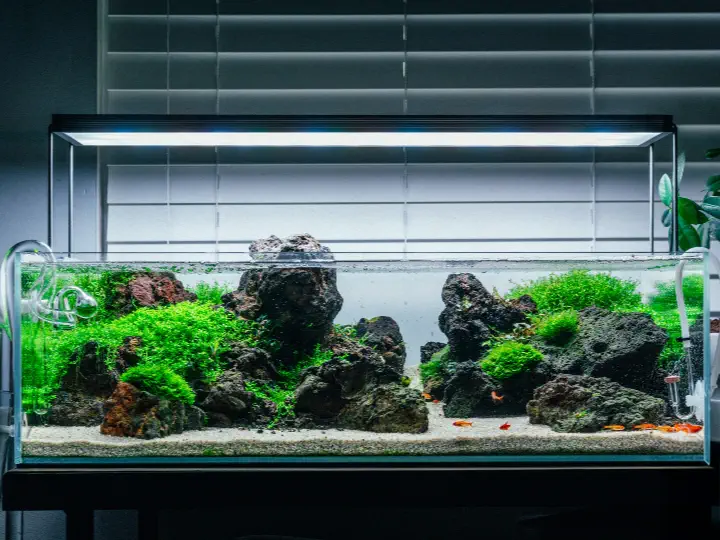
WRGB Series
A hugely popular Chinese-made LED line offering independently adjustable colour channels and app-based control, giving fine control over both spectrum and intensity as a tank matures — strong value for the features offered.
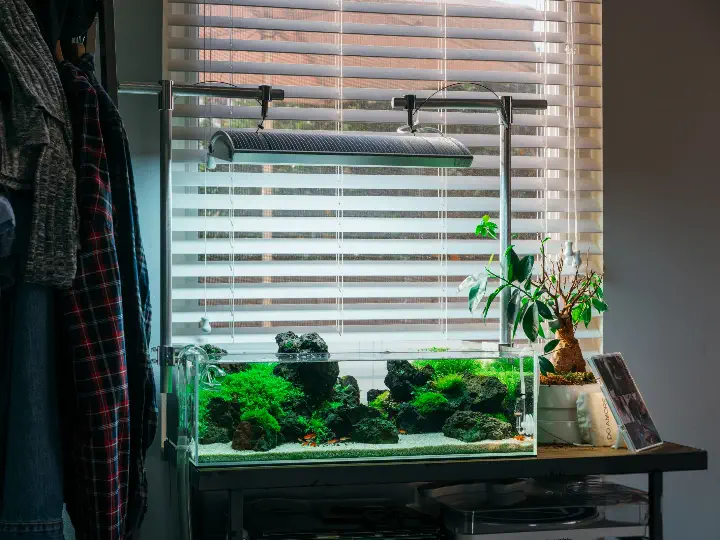
Solar RGB
The lighting counterpart to ADA's benchmark aqua soil — a premium, minimalist fixture built specifically for the nature aquarium aesthetic, still widely referenced by competition aquascapers as a design and performance standard.
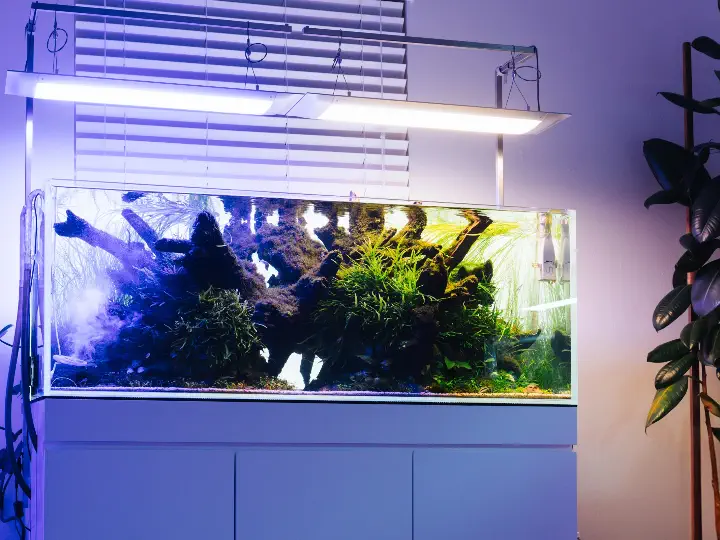
Hyperspot
A premium Polish-made spotlight fixture that uses focused reflectors and RGB+ LED modules to drive nearly all of its output straight down into the tank, giving vivid colour rendition and strong PAR for deep or heavily planted aquascapes with minimal glare and no need for shades.
Did You Know
PAR Isn't Uniform Across the Tank
PAR is typically highest directly under the centre of the fixture and drops off toward the edges and corners — a common reason plants in the corners of a tank grow slower or leggier than those in the centre.
LEDs Dim Over Time
LED output gradually degrades over years of use, meaning a fixture that provided ample PAR when new may fall short a few years later even at the same brightness setting — worth reassessing if plant growth unexpectedly slows.
Glass Lids Cut Light Significantly
A glass lid or condensation cover can reduce light penetration by 10–30%, especially once mineral deposits build up — cleaning the lid regularly is an easy way to recover lost intensity.
Ramping Reduces Shock
Fixtures with a sunrise/sunset ramping feature, rather than an abrupt on/off, more closely mimic natural daylight and can reduce fish stress and startled behaviour at lights-on.
More Light Doesn't Mean Faster Growth Forever
Beyond a certain intensity, plants can't use additional light any faster — excess light past that point does nothing for growth and only raises the risk of algae if CO2 and nutrients can't keep pace.
Red Plants Need More, Not Less, Light
Vivid red plant colouration is a stress-and-light response — red-leaved species like Rotala typically need higher PAR than green species to show their best colour, not less.
Matching Light to CO2 & Nutrients
Low-Tech Approach
Keep light intensity low to moderate and skip pressurised CO2 entirely, relying instead on the CO2 naturally available in the water. This is the single most reliable way to avoid algae as a beginner — low light simply can't outpace what your tank can supply.
Match Your Light
- Keep PAR in the 20–40 range at the substrate
- Choose easy, low-light plants: Anubias, Java Fern, Cryptocoryne, mosses
- Consider a shorter photoperiod (6 hours) if algae appears
What to Expect
- Slower, steadier growth with far less maintenance
- Much lower risk of algae outbreaks even with imperfect dosing
- Not suited to carpet plants or high-colour stem plants
High-Tech Approach
Run higher light intensity to support fast growth, dense carpets, and vivid colour — but only if CO2 injection and a full fertiliser dosing routine are dialled in to match. Increasing light without also increasing CO2 and nutrients is the most common single cause of algae in the hobby.
Match Your Light
- Every meaningful light increase should be paired with a CO2 and nutrient increase — never raise one without the others
- Use a drop checker to confirm stable, adequate CO2 before pushing light higher (see our CO2 Systems guide)
- Dose a complete fertiliser routine (macro and micro nutrients) to match plant demand at higher light
What to Expect
- Fast growth, dense carpets, and the vivid colour seen in competition aquascapes
- Considerably more maintenance — regular trimming, dosing, and water changes
- Higher algae risk if any single element (light, CO2, or nutrients) falls out of balance
Common Lighting Mistakes
| Mistake | What Happens | Fix |
|---|---|---|
| Photoperiod too long | Green water, green spot algae | Reduce to 6–8 hours; use a timer |
| Light too intense for CO2/nutrients | Black beard, staghorn, hair algae | Reduce intensity or increase CO2/dosing to match |
| Fixture mounted too high | Weak, leggy growth despite "bright" light | Lower fixture; check actual PAR at substrate |
| Old, degraded LEDs | Gradually slowing growth over time | Test output or replace ageing fixtures |
| Sudden large light increase | Algae outbreak within days | Increase intensity gradually over weeks, not all at once |
Algae Is Usually a Lighting Symptom, Not a Lighting Problem
If you're fighting recurring algae, the cause is almost always an imbalance between light, CO2, and nutrients — not a "bad" light itself. See our full Algae Identification & Control guide to diagnose the specific type and trace it back to the root cause.
Aquascape Lighting in South Africa
Quality planted-tank-specific LED fixtures are increasingly available through South African aquascaping specialists, though budget and mid-range options are far more common in general pet stores — check actual PAR output where possible rather than relying on marketing claims about "full spectrum" or wattage-equivalent brightness.
Load shedding makes a reliable timer or smart plug worth the investment — an inconsistent, load-shedding-interrupted photoperiod can itself contribute to algae by disrupting the steady light/CO2/nutrient balance a tank settles into over time.
Second-hand LED fixtures from experienced aquascapers are common at ECAAC club sales — often a better-value entry point into serious planted tank lighting than a budget new fixture with unverified PAR output.
Dialling In Your Lighting?
ECAAC members run everything from simple low-tech tanks to competition-grade high-light aquascapes and are always happy to help you match your lighting to your CO2 and nutrient setup.