
Medaka — Japanese Rice Fish
A small, tough, endlessly variable fish from the flooded rice paddies of East Asia. Bred in Japan for centuries into hundreds of colour forms, medaka thrive in conditions that defeat most tropicals — hard water, no heater, and a sunlit tub on the patio.
Origin
The medaka, Oryzias latipes, is a tiny ricefish native to Japan, Korea, China and Taiwan, where it lives in the warm, shallow, still water of rice paddies, irrigation ditches and slow lowland streams. These are sun-baked habitats with wide daily temperature swings, dense algae and abundant plant cover — and the fish is built to match: barely 3–4 cm long, flat-backed for surface feeding, and remarkably tolerant of conditions that would kill a delicate tropical.
Medaka have been kept in Japan since at least the Edo period, and orange-red forms were being selectively bred as ornamental fish centuries ago. That head start has produced a hobby of extraordinary depth: modern Japanese medaka keeping recognises hundreds of named varieties, distinguished by body colour, scale iridescence, fin shape, and even the way light reflects off the back when the fish is viewed from above.
Alongside the ornamental tradition, medaka became one of biology's key model organisms. They breed readily, mature in weeks, and have transparent eggs that make embryonic development visible under a simple microscope — which is why they have been used in genetics and developmental research for over a century.
Because they want hard, alkaline, unheated water, medaka sit at the opposite end of the spectrum from our blackwater and killifish guides — and much closer in water chemistry to a hard-water rift lake setup, despite being a completely different kind of fish.
Water Parameters
Medaka are the mirror image of most soft-water tropicals: they actively prefer hard, mineral-rich, slightly alkaline water. In much of South Africa that means plain dechlorinated tap water is close to ideal, with no RO unit, peat or buffering products needed. They are also genuinely temperate — comfortable without a heater for most of the year, and known to survive from just above freezing to the mid-30s °C in the wild, though those extremes are for survival, not day-to-day keeping.
Did You Know
The First Fish to Mate in Space
Medaka flew aboard the Space Shuttle Columbia in 1994 and became the first vertebrates observed to mate and produce healthy young in orbit — the fry hatched in microgravity and developed normally.
Transparent Eggs
Medaka eggs are clear, tough, and large enough to watch with a cheap microscope. You can literally see the heart begin to beat and the eyes form — which is why they became a laboratory model organism worldwide.
Eggs Carried in a Bunch
Unusually, a spawning female trails her fertilised eggs in a visible cluster hanging from her vent for several hours before brushing them off onto plants — a behaviour you can watch happen in an ordinary tub.
Colour Seen From Above
Japanese keepers traditionally view medaka from above in shallow bowls and tubs, not through glass. Many varieties — especially the metallic-backed Miyuki types — are bred specifically for how they look from that top-down angle.
Green Water Is a Feature
In most aquaria a green algae bloom is a failure. In medaka tub culture it is the goal — suspended algae feeds fry, stabilises the water, and deepens the fishes' colour.
Centuries of Selective Breeding
Ornamental medaka breeding dates back to the Edo period, and the pace has accelerated dramatically — the number of recognised named varieties in Japan has grown from a handful to several hundred within living memory.
Variety Spotlight
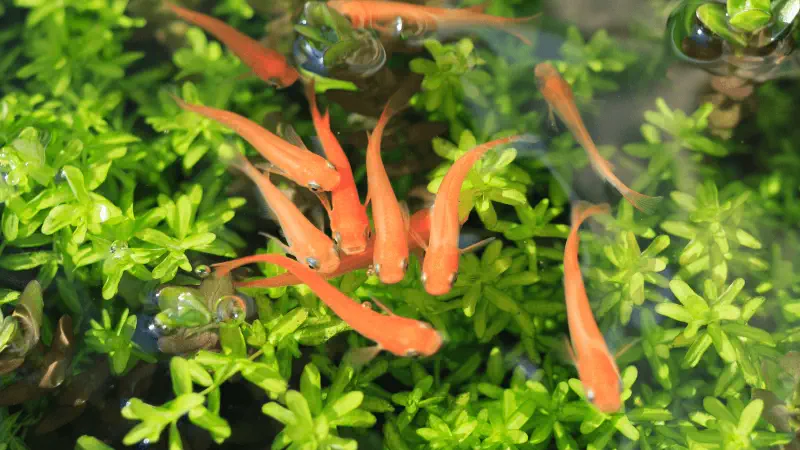
Himedaka
緋メダカThe original ornamental medaka and still the most widely kept — a warm orange-red fish selectively bred from the wild brown form centuries ago. Hardy, inexpensive and an ideal first variety.
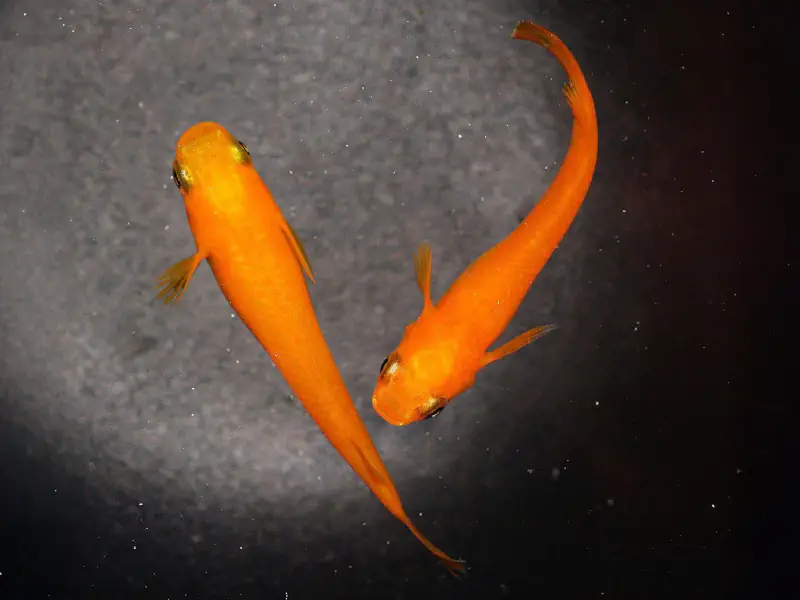
Youkihi
楊貴妃Named after a legendary Tang-dynasty beauty, Youkihi is bred for an intense, saturated orange-red that deepens with good food and bright light. One of the varieties that ignited the modern medaka boom.
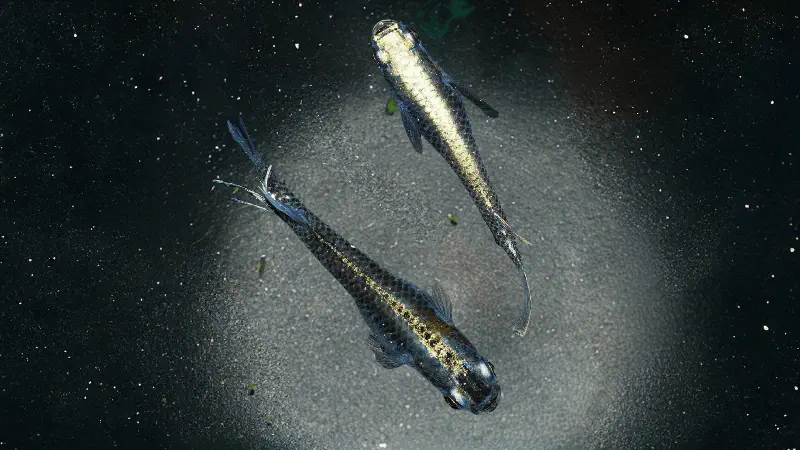
Miyuki
幹之Distinguished by a band of brilliant blue-white iridescence running along the spine, graded by how far the shine extends. Bred specifically to be admired from above in a shallow bowl or tub.
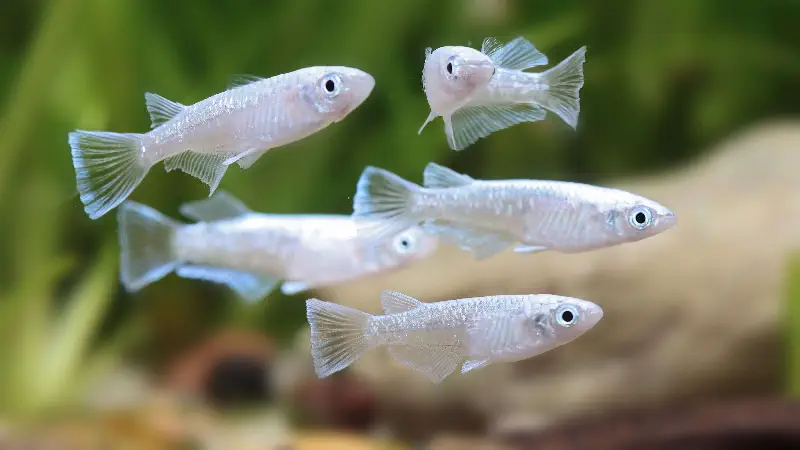
Shiro / Platinum
白メダカA clean, opaque white to pale cream fish that shows up beautifully against dark tub walls and green plants. Simple, elegant, and an excellent contrast fish alongside orange varieties.
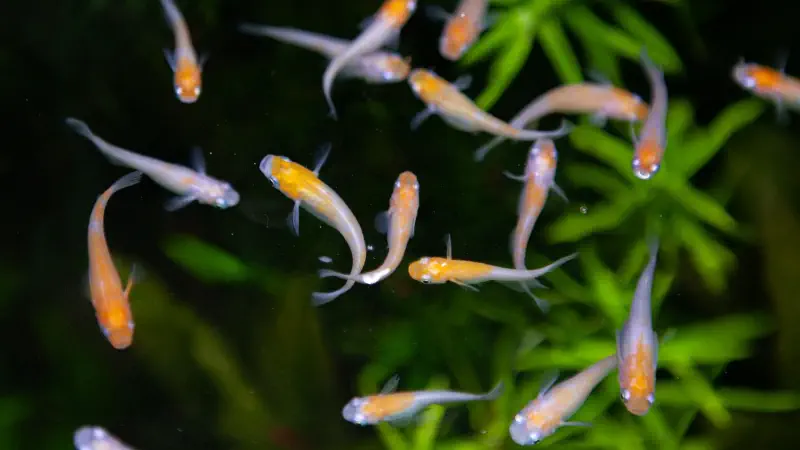
Kouhaku
紅白Borrowing the name and aesthetic of the koi world, Kouhaku medaka carry patches of red on a white body. Patterning varies between individuals, so selecting good stock is part of the appeal.
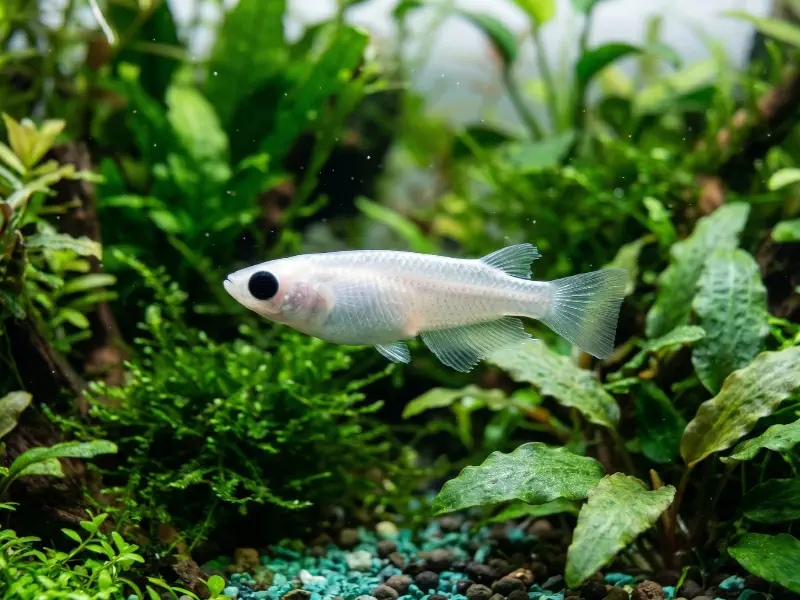
Panda
パンダメダカA translucent-bodied variety with strikingly dark, prominent eyes that give it a panda-like face. The see-through body means internal organs are faintly visible — a favourite with children.
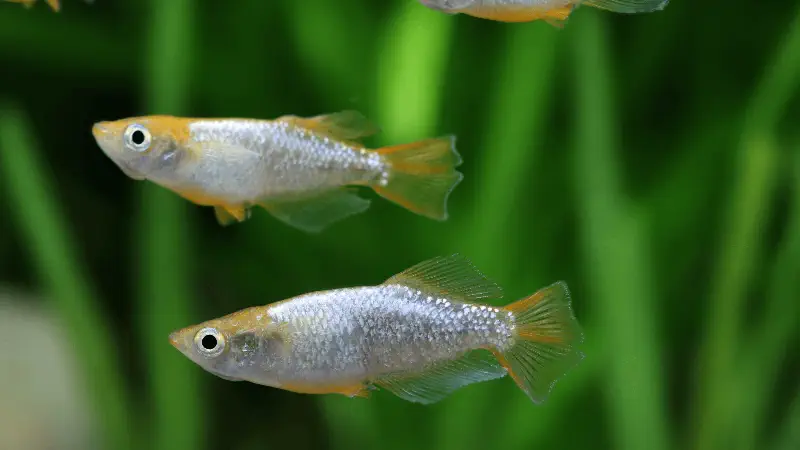
Tumuki
ツムキA striking modern colour line combining a warm golden head, iridescent pearl-silver flanks and glowing orange fin edges. One of the newer strains to catch on outside Japan, prized for how the colours shift with the light.
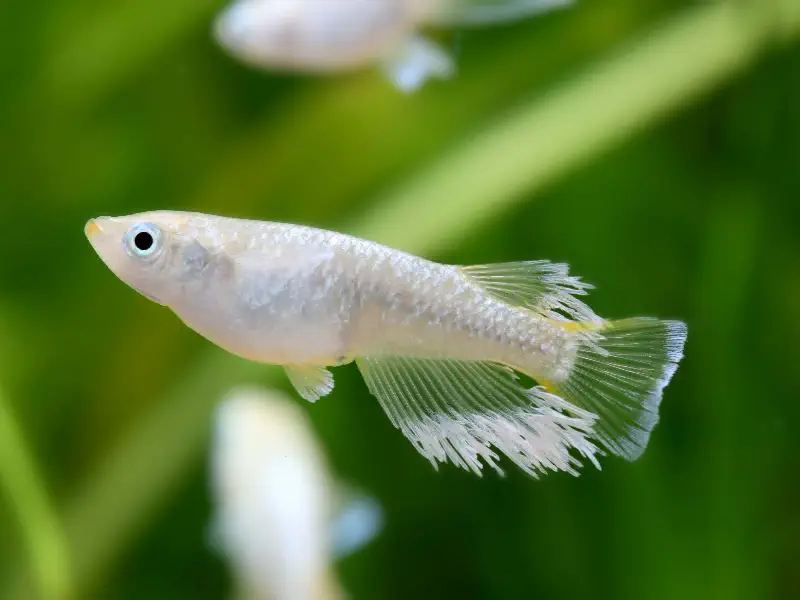
Hikari / Long-Fin
光メダカA body-and-fin type in which the dorsal fin mirrors the anal fin and the tail becomes diamond-shaped, often combined with extended finnage. Frequently crossed into colour lines to add flow and movement.
Breeding Medaka
Given warmth, long daylight and good feeding, medaka spawn almost daily through the warm months. Ripe females release a cluster of fertilised eggs that remains attached near the vent, trailing beneath her like a bunch of tiny glass beads for several hours, before she brushes them off onto fine-leaved plants, roots or a wool spawning mop.
Males court almost constantly once conditions are right, and a male-heavy group leads to exhausted, harassed females and fewer eggs rather than more. Aim to keep females equal to or outnumbering males — for example, 2 males with 3–4 females, or 4 males with 6–8 females. A lone pair can work, but a small group gives females room to retreat.
Medaka are strongly photoperiod-driven spawners: day length matters as much as temperature. Both wild and captive fish generally need roughly 13 hours of light or more before they switch into breeding mode, which is why spawning tracks the seasons so tightly outdoors. Indoors, a 13–14 hour light cycle plus warm water keeps fish spawning continuously.
Collecting & Hatching
Adults will eat their own eggs and fry, so the usual approach is to lift the mop or plants every day or two and move them to a separate hatching container. Eggs are unusually tough — they can be gently rolled between damp fingers to separate them — and hatch in roughly 7–14 days depending on temperature, faster when warm.
Raising Fry
Newly hatched fry are tiny and stay near the surface. They need genuinely small first foods: infusoria, powdered dry fry food, vinegar eels, or — best of all — the natural plankton in a mature green-water tub. Move them onto newly hatched brine shrimp as soon as they can take it. Fish often reach breeding condition in two to three months.
Keeping Lines Clean
Because so many varieties interbreed freely, serious medaka keepers hold each line in its own tub. Mixing varieties is fine for a display, but the offspring will be a muddle of intermediate colours rather than the distinct form you started with — worth knowing before combining an expensive Miyuki trio with a tub of Himedaka.
Keeping Medaka
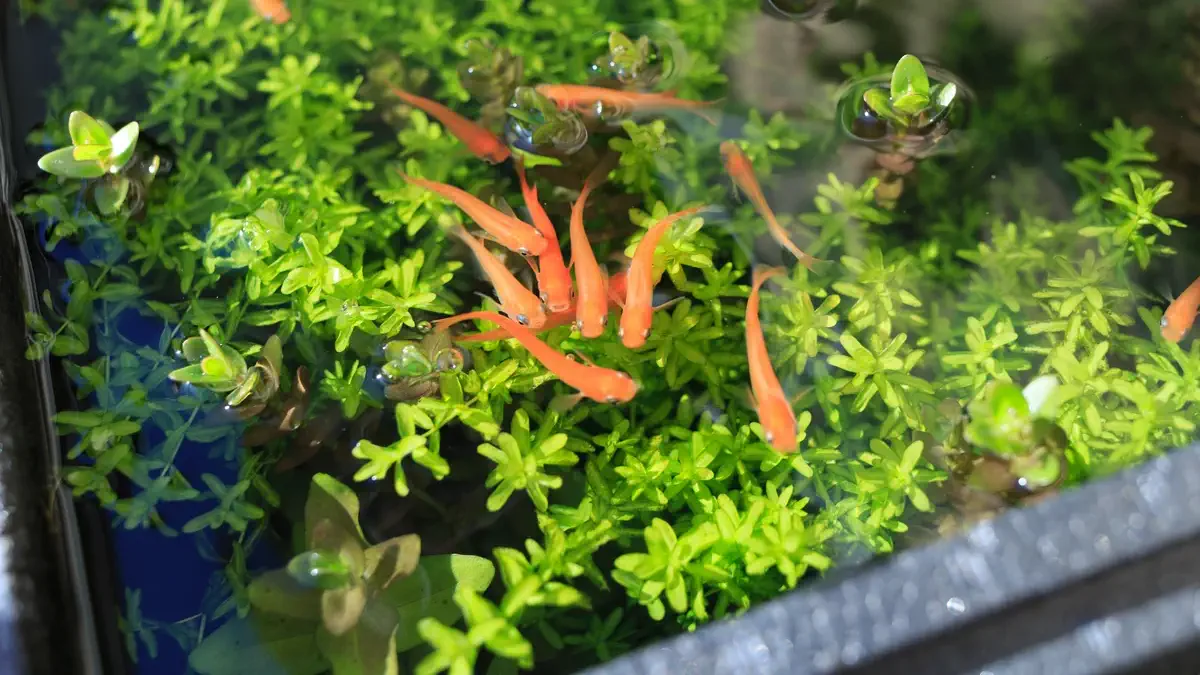
Outdoor Tub Culture
- The traditional Japanese method and arguably the best — a shallow, wide container of 20 litres or more in a bright spot, viewed from above
- Half-barrels, mortar tubs, ceramic bowls and plastic crates all work; depth matters far less than surface area and light
- No filter and no heater needed in most of South Africa — plants, algae and a large water volume do the work
- Let the water go green. Suspended algae feeds fry, buffers the water and deepens adult colour
- Provide partial shade in high summer, and avoid tubs that could freeze solid or overheat on a hot Karoo or Lowveld afternoon
- Cover with mesh if cats, birds or dragonfly larvae are a concern
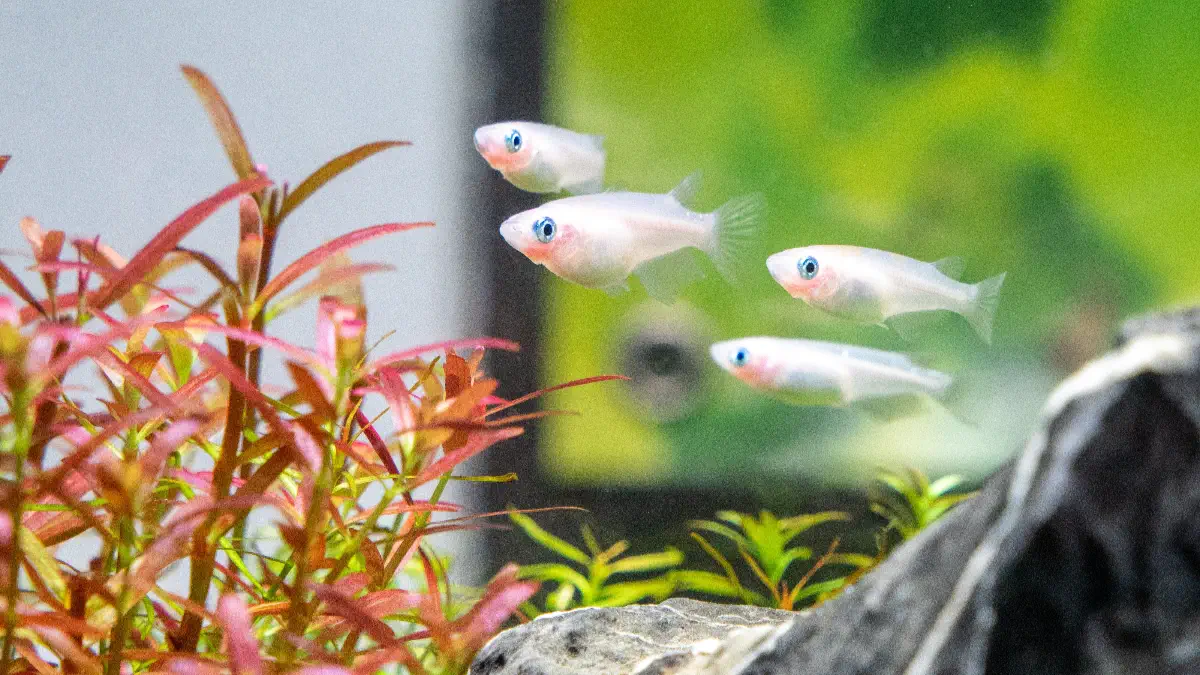
Indoor Tanks
- A 40–60 litre tank suits a group of 8–12; they use the top half of the water, so footprint matters more than height
- Gentle filtration only — sponge filters are ideal, as medaka dislike strong current
- Plain hard tap water (dechlorinated) is usually perfect; skip the RO unit, peat and buffers
- Floating and fine-leaved plants — hornwort, water sprite, guppy grass, or a wool mop — give spawning sites and cover
- A lid is worth having, though medaka are far less determined jumpers than killifish
- Feed a varied diet of quality flake or micro pellets plus live or frozen daphnia and brine shrimp for colour and conditioning
Medaka in South Africa
Medaka suit the South African climate unusually well. Across most of the country they can be kept outdoors in tubs for the greater part of the year with no heater and no filter, which makes them one of the cheapest and lowest-effort fish to breed at scale — and a genuinely good project for members with a sunny patio or courtyard rather than a fish room.
Water chemistry is the other advantage. Much of South Africa's tap water is moderately hard and slightly alkaline, which is precisely what medaka want. Where soft-water species need RO units, peat and careful buffering, medaka generally thrive on plain dechlorinated tap water.
Availability is the catch. Medaka are still a niche fish locally and are not a shelf staple in most general aquarium shops, so the practical routes are specialist breeders, club members and ECAAC auctions and swaps. If you're importing, check the current permit and import requirements before ordering. Breeding a named variety and holding the line true also makes an excellent submission for the club's Breeding Awards Program.
One responsibility note: medaka are hardy, adaptable and tolerant of a wide temperature range — exactly the traits that make a fish invasive if released. Never tip a tub into a stormwater drain, stream or wetland. Rehome surplus fish through the club or a fellow hobbyist instead.

The Eastern Cape Aquarium & Aquascaping Club is proudly sponsored by Judy's Planted Tank — a specialist Medaka breeder stocking a range of named strains alongside planted-tank supplies. Visit www.judysplantedtanks.co.za for all your Medaka needs.
The Japanese Breeding Scene
Exactly how many named medaka strains exist is genuinely debated, since so much depends on where a "strain" is judged distinct enough to name. Estimates commonly range from around 450 up into the 700s, with figures near 500 quoted most often — and the count keeps climbing, as breeders continue to fix and register new colour, scale and fin mutations most years.
品評会 · Shows & CompetitionsOrnamental medaka breeding is a serious competitive hobby in Japan, not just a quiet houseplant-style pastime. Large medaka shows and competitions are held around the country, with fish judged across categories such as top-view colour and pattern, side-view body shape, eye characteristics and tricolour marking. Specialist medaka shops, breeder associations and dedicated media support a scene with much the same intensity, grading and prized bloodlines as the koi or betta show worlds.
養殖場 · FarmsCommercial medaka farms behind this scene are often strikingly simple — rows of outdoor tubs or shallow vinyl-house ponds rather than elaborate indoor systems — yet highly productive across dozens of strains at once. Even at that scale, final selection is typically still done by eye: a head breeder walks the tubs and hand-picks the best individuals of each strain to carry the line forward, since colour depth, pattern and body shape are judgements no automated system replicates as reliably as an experienced breeder.
Ready to Start a Medaka Tub?
ECAAC members keep and breed a growing range of medaka varieties, and can advise on tub setup, variety selection and raising fry through a South African summer.